

From the Controller to the Command Post: Why the Next Defense Workforce May Already Be Gaming

Parents worry that their kids spend too much time playing video games. The U.S. military has been watching the same kids and drawing a different conclusion.
So has industry. At the end of October, Anduril said its Arsenal-1 factory in Pickaway County, Ohio, had passed 300 employees. That’s more than double the 143 people it had in July, and it’s already past the company’s year-end target of 250. The factory builds the YFQ-44A Fury, a semi-autonomous combat aircraft for the Air Force, and it is hiring faster than planned.
That hiring didn’t happen in isolation. Over a few weeks this fall, the Pentagon and the Army moved autonomy from experiment toward profession:
-
Sept. 30, 2026: Secretary Pete Hegseth announced plans for a four-star Autonomous Warfare Command, with service-like authorities, targeted for Oct. 1, 2027. He said the military needs “career paths for a new generation of autonomous warfighters.”
-
Oct. 1, 2026: An Army order directed manning slots for the new 390A Robotics Technician and the enlisted 15X Tactical Unmanned Aircraft Systems Specialist in every applicable Army unit.
-
Oct. 2, 2026: The Army graduated its first 10 390A Robotics Technicians at Fort Bragg, North Carolina. It is a new warrant officer career field built around robotic and autonomous systems.
A new career field, a new command, and a factory hiring ahead of schedule. These are moving past the pilot stage. They show a profession being built, and every profession needs a pipeline. The question for every economic developer, educator and workforce board is where that pipeline will come from.
For site selection, three things follow. Technician depth will matter more than engineer headcount. Regions near the installations training these soldiers gain an edge. And a documented pipeline will beat a slide about STEM.
What the Army created
The 390A course runs 19 weeks. According to the Army, 14 of those weeks are technical training in computing networks, edge artificial intelligence, computer-aided design, additive manufacturing and radio-frequency systems. Students learn to build resilient mesh networks and autonomous systems that keep working without GPS or radio links, and to train machine-learning models that navigate and target using onboard sensors. The course ends with a “Prototype Capstone,” where students design, 3D-print and code a solution to a new problem under field conditions.
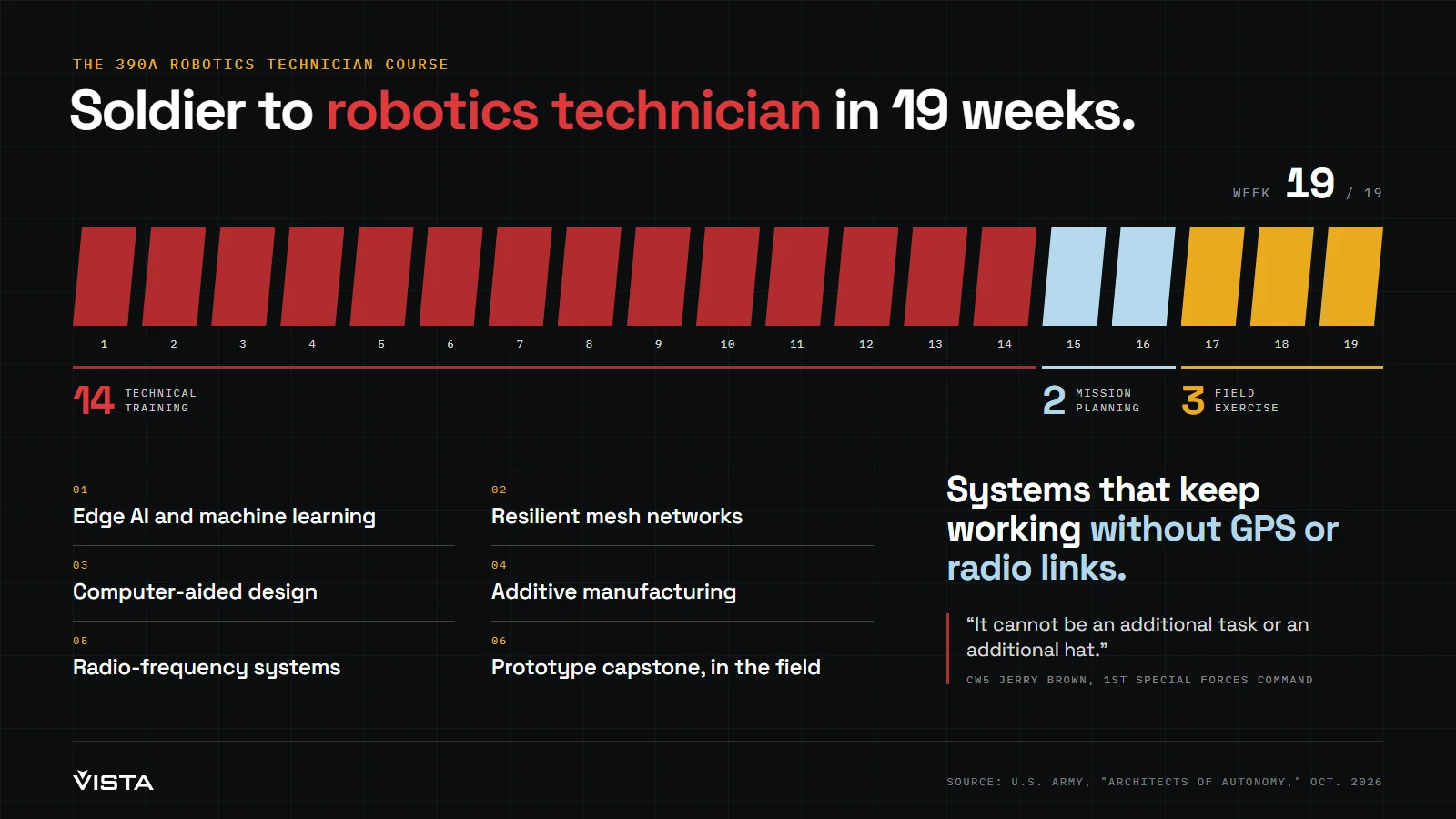
Graduates will serve as technical advisers to brigade and task force commanders. They will find vulnerabilities in friendly systems, develop countermeasures to enemy electronic attack, and keep robotic systems running when communications are cut off.
Chief Warrant Officer 5 Jerry Brown of 1st Special Forces Command said the work “cannot be an additional task or an additional hat.” Battlefields in Eastern Europe showed that cheap commercial drones and heavy electronic warfare turn operator-only skills into a single point of failure. The Army concluded it needs people who can fly the system, fix it, rewrite it and defeat the other side’s.
The first class came from Army special operations, but leadership has been direct about where this is headed. “We are scaling this across the Army,” said Gen. Christopher LaNeve.
The demand signal is measured in millions
For anyone in site selection, the workforce story only matters if the demand is real. In this case it is large:
-
One million drones. In November 2025, Army Secretary Dan Driscoll said the Army expects to buy at least one million drones over two to three years. At the time it bought roughly 50,000 a year.
-
Drone Dominance Program. The Pentagon’s roughly $1 billion effort to buy small, low-cost drones in competitive “Gauntlet” rounds, held at sites including Fort Benning, Camp Grayling and Fort Carson, has already moved into production orders. Gauntlet II results, posted in September 2026, line up orders for about 60,000 one-way attack drones from the top performers, and the next round is already scheduled.
-
Enlisted pipeline. The new 15X specialty, trained at Fort Huachuca, Arizona, combines the old operator and repairer jobs. Soldiers learn to assemble, fix and fly uncrewed aircraft. More than 250 had graduated by late August, and the brigade commander running the training expects about 770 by the end of 2026.
Someone has to build these systems, and that is where communities come in.
Where the factories and the jobs are landing
Industry is already making location decisions:
| Company | Location | Commitment |
|---|---|---|
| Anduril (Arsenal-1) | Pickaway County, Ohio | ~$1B facility; Fury semi-autonomous combat aircraft in production since March 2026, with an ALTIUS 600 line announced and Roadrunner and Barracuda to follow; 300+ employees as of late October (year-end target was 250), about 4,000 planned by 2035 |
| Anduril | Long Beach, California | Campus announced January 2026 (reported at ~$1B); about 5,500 direct jobs on site; opening mid-2027 |
| Skydio | New U.S. facility, site not yet announced (five times its current space) | $3.5B over five years; 2,000+ direct jobs and 3,000+ supply-chain jobs projected |
| Neros | Torrance, California | Five-year Army contract worth up to $500M for Archer FPV drones; 250,000 sq. ft. factory; company goal of 1M drones a year by 2028 |
Except for Arsenal-1’s current headcount, job and production figures are company projections, not confirmed hires or output. Contract values are ceilings.
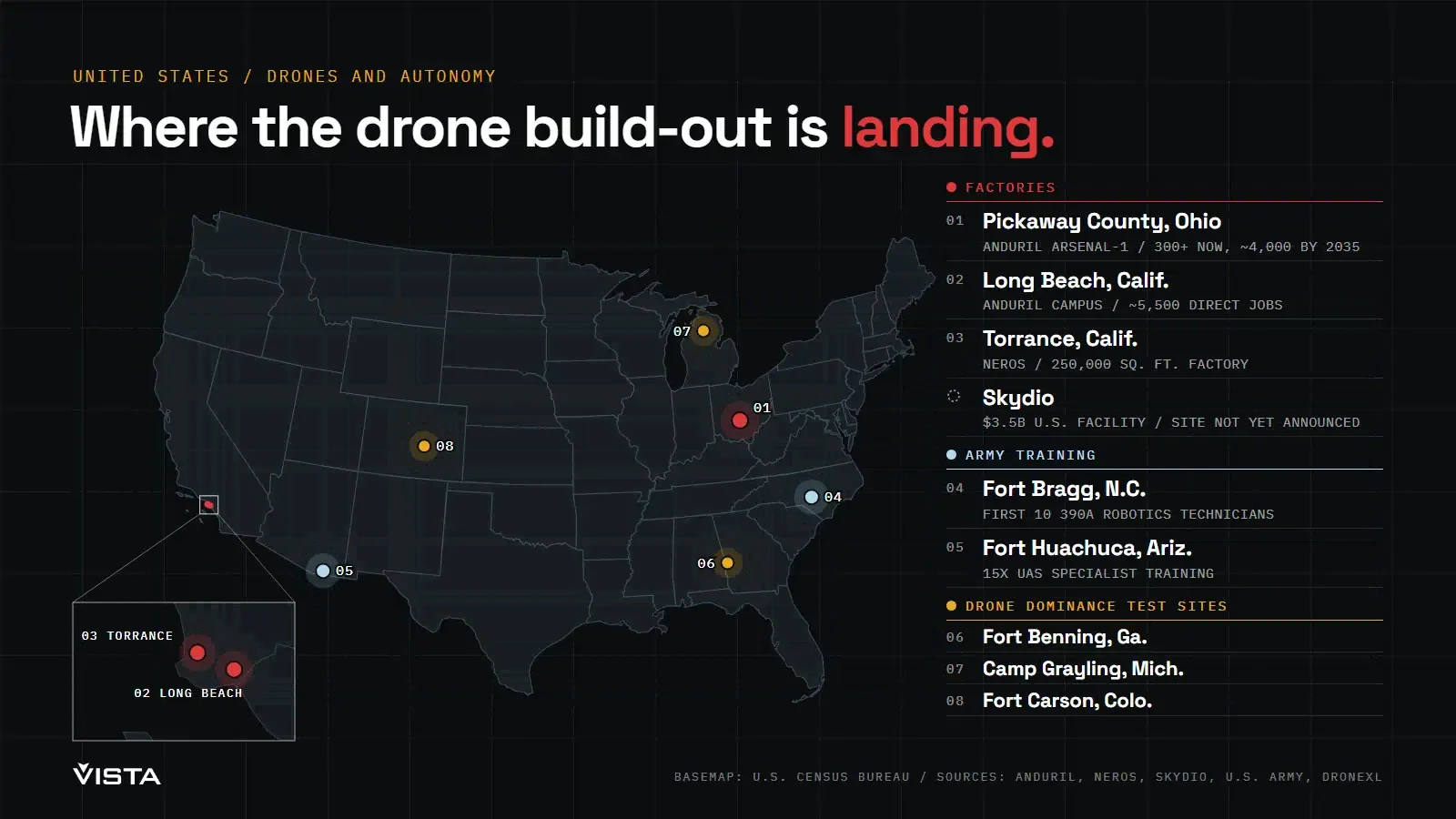
Look at the kind of work these factories create. The Fury, built for the Air Force’s Collaborative Combat Aircraft program, doesn’t have a pilot with a joystick. It flies semi-autonomously and is tasked from a laptop. The production floor is staffed by technicians who build each aircraft across 22 workstations. As autonomy grows, the demand shifts from people who fly drones to people who build, test, code and maintain them. That’s the same skill set the Army designed the 390A around.
The supply chain matters too. Skydio says it plans to direct more than $1 billion to domestic suppliers and invite suppliers to co-locate with it. Driscoll has said the Army wants motors, sensors, batteries and circuit boards made in a domestic supply chain instead of relying on China. That means the opportunity isn’t limited to the communities that land a prime’s factory. It reaches every region that can make a component, and every one of those plants will need technicians.
The skills are already being practiced at home
85% of U.S. teens play video games, and 41% play daily (Pew Research Center, 2024). Among boys the figure is 97%. Because nearly every teenager games, gaming alone doesn’t set a region apart. What sets a region apart is whether anyone turns that interest into a credential. Researchers and military trainers have started to notice what those hours build:
-
Cognition. An NIH-funded study of nearly 2,000 children ages 9 and 10, published in JAMA Network Open (2022), found that kids who gamed three or more hours a day did better on tests of impulse control and working memory than kids who never played. The study showed correlation, not causation, and the heaviest gamers also reported more attention problems, depression and ADHD symptoms.
-
Drone performance. In a 2024 Embry-Riddle Aeronautical University study of 62 pilots flying a simulated drone, the pilots who play video games adapted faster to the new environment and showed significantly better situational awareness.
-
In the field. An Army intelligence officer at a drone innovation cell in Germany told Business Insider in 2025 that his fastest learners were the soldiers who play video games when they get off work on Fridays.
-
In combat. At least one Ukrainian drone unit, the National Guard’s Typhoon unit, has said gamers make strong FPV pilots because of their reaction time and familiarity with controllers. Its operators also offer a sobering caveat: unlike in a game, there is no restart option.
That caveat is the point. Gaming isn’t the qualification. It’s the hook that gets a kid interested. The career requires coding, electronics, RF fundamentals, CAD, 3D printing, discipline and teamwork, and all of those can be taught if a young person has a reason to learn them.
What the jobs look like outside of uniform
For students and parents, the civilian side is just as concrete. Federal labor data shows:
-
Aerospace engineering and operations technologists and technicians earned a median of $82,890 in May 2025. Employment is projected to grow 12% from 2025 to 2035, which BLS calls “much faster than average.” The typical entry requirement is an associate’s degree.
-
Electro-mechanical and mechatronics technicians, the federal category closest to robotics technicians, earned a median of $73,900, with about 1,400 openings a year projected over the next decade. Employment is projected to grow 3%, about as fast as average.
-
FAA remote pilot certifications issued passed 493,000 by the end of 2025, an increase of more than 70,000 in a single year.
These are well-paying technical jobs that do not require a four-year degree, in an industry that is hiring faster than it planned. The BLS numbers also lag the market. They don’t yet show the factories coming online in Ohio and California, and they have no category for “drone technician.” If and when that category appears, the regions that planned for it will already have the people.
Communities are already building this pipeline
Some places started early:
-
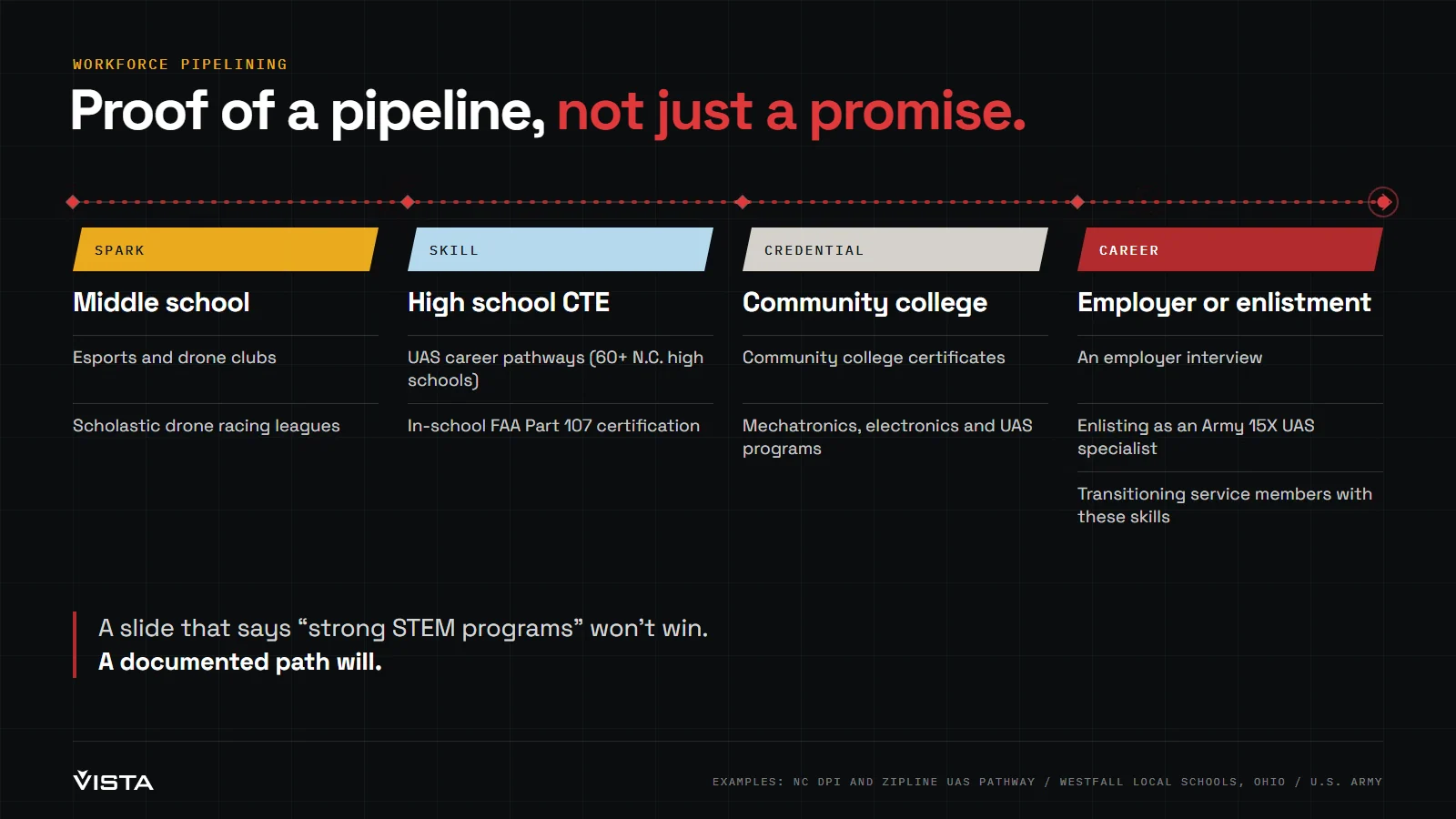
North Carolina’s Department of Public Instruction partnered with autonomous delivery company Zipline to offer an uncrewed aircraft systems career pathway in more than 60 high schools, with a guaranteed interview for qualifying students who complete it.
-
Pickaway County, Ohio, started a scholastic drone-racing club with OSU Extension and Circleville City Schools in 2019, the first in the county to compete in a league. In 2025, Westfall Local Schools added an in-school FAA Part 107 remote pilot certification course, supported by a community foundation grant and several local partners. That same county is now home to Anduril’s Arsenal-1. The drone club didn’t land the factory, but the county now has a local starting point for the technicians it needs.
-
Scholastic drone racing leagues, like the one Pickaway County’s club joined, turn it into a competitive “tech sport.” Students build, program, fly and repair their own aircraft.
None of these programs could have predicted a specific factory. They built the conditions that make a community competitive when a project goes looking for a home.
What this means for site selection
My Vista colleague Jeff Troan recently laid out how aerospace and defense companies choose locations in The Defense Industrial Base Rebuild (Area Development, Q3 2026). His bottom line is that “labor remains king.” Companies look for labor sheds holding five to ten times the headcount they need. When they run the analysis nationally, they routinely find five to ten overlooked markets that can compete with the traditional hubs at a lower cost. He also separates two ideas: workforce development, which fills today’s gaps, and workforce pipelining, which prepares for growth that hasn’t arrived yet.
Drones and autonomous systems are a clear case for pipelining. The career fields are brand new and the factories are still ramping up, so no region has a deep bench of “robotics technicians” yet. The communities and regions that build one now will stand out when the analysis runs. From the site selection side of the table, here is how I would expect defense and autonomy companies to evaluate communities over the next few years:
-
Technician depth over engineer headcount. Primes and new entrants can recruit engineers nationally. Technicians, assemblers and test operators come from within commuting distance. Expect project teams to ask about community college capacity in mechatronics, electronics and UAS programs.
-
Proximity to military demand. Installations that train and test these systems, such as Fort Bragg, Fort Huachuca, Fort Benning and Fort Carson, will draw suppliers and create a steady flow of transitioning service members with exactly these skills. Over time, soldiers leaving these fields, especially 15X specialists, will bring hands-on build, repair and flight experience that maps closely to technician roles.
-
Proof of a pipeline, not just a promise. A slide that says “strong STEM programs” won’t win. A documented path from middle school esports and drone clubs to a high school CTE pathway, to a community college certificate, to an employer interview will.
-
Supply-chain readiness. Reshoring motors, batteries, sensors and circuit boards will create mid-size projects in places that never expected to compete for defense work.
The bottom line
This isn’t an argument for more screen time. It’s an argument for showing young people where their interests can lead.
Workforce starts long before hiring. It isn’t college versus the trades. It’s about helping young people see all the options available to them. For a kid who loves gaming, a career in drones, robotics or autonomous systems, in uniform or in industry, may be one they never knew existed.
The Army has made robotics its own career field. The Pentagon is building a command around it. Industry is spending billions on factories to supply it, and in Ohio, hiring is already ahead of schedule. The question for every community is whether its young people will be ready to fill those jobs.
If you are planning a drone, autonomy or defense facility, test a region’s technician pipeline before it makes your shortlist, not after. That workforce screen is where Vista’s aerospace and defense site selection work starts.
What would it take to turn a gaming hobby into a career pathway in your community? If yours is already building one, I’d like to hear about it.
Sources
Every fact in this post was checked against these pages, most recently on Nov. 3, 2026.
Show all 33 sources
Army, Pentagon and programs
- U.S. Army: “Architects of Autonomy: Army activates 390A Robotics Technician MOS” (Oct. 2026)
- DefenseScoop: first 390A graduates (Oct. 2, 2026)
- Task & Purpose: Army shifts soldiers into robotics and space jobs (Oct. 2026)
- Task & Purpose: Army 15X drone MOS (Aug. 2026)
- Air & Space Forces Magazine: Autonomous Warfare Command (Sept. 30, 2026)
- ExecutiveGov: Army plans to buy 1 million drones (Nov. 2025)
- DefenseScoop: Drone Dominance Program (Dec. 2025)
- Breaking Defense: Pentagon begins receiving small drones (June 2026)
- DroneXL: Gauntlet II results (Sept. 2026)
Industry
- Ohio Tech News: Anduril surpasses 300 employees at Arsenal-1 (Oct. 30, 2026)
- Breaking Defense: Fury production starts at Arsenal-1 (Mar. 2026)
- ClearanceJobs: Arsenal-1 jobs (Apr. 2026)
- SOFREP: YFQ-44A tasked by laptop
- Defense News: Air Force unit executes test of Anduril’s semiautonomous combat drone (Apr. 17, 2026)
- Governor of California: Anduril Long Beach campus (Jan. 26, 2026)
- Manufacturing Dive: Anduril Long Beach expansion
- Skydio: $3.5B U.S. manufacturing commitment (Apr. 2026)
- GovConWire: Neros $500M Army contract
- Neros: Project Millennium factory
- Tectonic Defense: Neros lands Army contract worth up to $500M (July 17, 2026)
- Jeff Troan: “The Defense Industrial Base Rebuild,” Area Development (Q3 2026)
Gaming and skills research
- Pew Research Center: “Teens and Video Games Today” (May 2024)
- NIH: video gaming and cognitive performance in children (Oct. 2022)
- Potdar & Dattel (Embry-Riddle): video gaming and situation awareness operating UAVs (HFES, 2024)
- Business Insider via AOL: Army captain on gamers as drone pilots (Aug. 2025)
- Business Insider via AOL: Ukraine’s Typhoon unit on gamers as drone pilots (Feb. 2025)
Jobs and workforce programs
- BLS: Aerospace Engineering and Operations Technologists and Technicians
- BLS: Electro-mechanical and Mechatronics Technologists and Technicians
- FAA Aerospace Forecast FY2026 to 2046: UAS chapter
- NC DPI and Zipline UAS pathway (June 2024)
- Westfall Local Schools: drone program grant (Nov. 2025)
- OSU Extension Pickaway County: Scholastic Drone Racing
- OSU Community Development: drone racing club takes Pickaway County (Jan. 2019)
Recent Posts
See All
Battery and Semiconductor Manufacturing Site Selection: Power, Water, Workforce and Speed
Andrea Dishler on battery and chip plant site selection: why power, water, workforce and permitting decide the site, and why cheap on paper often isn't.
Read more →
Winning the Incentive Is Only Half the Job
Julie Miller on why winning an incentive is only half the job, and how Vista and Navigator help companies keep the incentives they worked to secure.
Read more →
Incentive Compliance: What Happens After the Award
Julie Miller, CCIP, on incentive compliance: what an agreement asks of you after it's signed, where companies get caught, and how to keep the award.
Read more →