

Colorado's Incentive Challenge: Turning Incentives into Real Value

Colorado remains one of the nation’s strongest locations for aerospace, defense, advanced manufacturing, and technology investment. The state offers a highly skilled workforce, a mature aerospace ecosystem, world-class research institutions, and a strong culture of innovation.
Yet Colorado faces increasing competition for major projects. According to the Colorado Chamber Foundation’s 2025 Relocations Tracker, released in April 2026, public reports since 2019 document 98 instances of companies relocating from Colorado, moving or scaling back operations in favor of other states, or passing over Colorado for new projects, including 27 in 2025 alone. Where jobs data was available, those decisions represented more than 13,600 jobs, with Texas emerging as the most common destination (21 companies) for projects selecting another state.
For aerospace, defense, and advanced manufacturing executives evaluating major investments, one challenge consistently surfaces during the site selection process: how to convert available incentives into meaningful business value.

Incentive Value vs. Incentive Monetization
A common misconception in economic development is that incentive value and realized value are the same thing.
Economic development proposals are often presented as large dollar figures, but the real question is whether a company can actually utilize the incentives being offered.
This distinction is particularly important for aerospace, defense, electronics, satellite, and advanced manufacturing projects. Certain incentive programs may appear highly competitive on paper, but their true value depends on a company’s tax structure, capital investment profile, workforce requirements, and long-term operational strategy.
The most successful incentive strategies focus not on securing the largest incentive package, but on maximizing the value a company can actually realize.
The Role of JGITC
One of Colorado’s primary economic development tools is the Job Growth Incentive Tax Credit (JGITC).
JGITC is a performance-based program that provides state income tax credits tied to job creation and payroll growth. For qualifying projects, it can generate meaningful long-term value while encouraging continued investment within Colorado.
However, as with many tax-credit-based incentives, the value ultimately depends on a company’s ability to utilize the credits. For some aerospace, defense, and advanced manufacturing companies, incentive monetization becomes just as important as incentive eligibility.
The program is also here to stay: legislation signed in May 2026 extended the state’s authority to approve new JGITC awards through tax year 2034.
This is where incentive strategy becomes critical.
How Colorado’s CHIPS Refundable Tax Credit Program Turns Credits into Cash
Another tool that deserves significant attention is Colorado’s CHIPS Refundable Tax Credit Program, created under House Bill 23-1260 to help the state capture opportunities arising from the federal CHIPS and Science Act.
While many companies associate CHIPS exclusively with semiconductor fabrication facilities, Colorado’s program supports a broader range of advanced manufacturing activities. For qualifying semiconductor and advanced manufacturing companies, and with approval from the Colorado Economic Development Commission, the program allows the Job Growth Incentive Tax Credit, along with five Enterprise Zone tax credits, to be refunded at 80% of its value.

This is a critical distinction. The JGITC is normally a nonrefundable credit, which means its value depends on a company’s state income tax liability. Through the CHIPS Refundable Tax Credit Program, that same credit can be converted into cash: value that is realized through project implementation and operational growth rather than future tax position.
The program also illustrates why timing and strategy matter. Capacity is capped at $15 million per year and $75 million overall through fiscal year 2028-29. Demand has been so strong that, as of July 2026, the full amount has been allocated to projects including major aerospace, semiconductor, and quantum wins. The state has signaled support for extending the program, and capacity can reopen when approved projects do not move forward. The companies that captured this value were the ones positioned to apply when capacity was available, which is exactly the discipline a coordinated incentive strategy provides.
Rather than viewing JGITC and the CHIPS program as separate opportunities, sophisticated incentive strategies treat monetization pathways as a core part of the business case from day one.
Workforce Development: The Opportunity Now Tax Credit
Colorado has also renewed its commitment to workforce development. While the state’s original Opportunity Now grant program, which awarded nearly $90 million to workforce training partnerships since 2023, has concluded, it has been succeeded by a new tool aimed directly at employers.
Beginning in tax year 2026 and available through 2032, the Opportunity Now training investment tax credit allows qualifying companies in targeted industries, including advanced manufacturing and semiconductors, to earn a refundable state income tax credit of up to 50% of the costs of facility improvements and equipment purchases associated with worker training programs. Credits are reserved in advance through a competitive annual application to the Colorado Office of Economic Development and International Trade, with statewide capacity capped each year, and early rounds have been heavily oversubscribed.
Because the credit is refundable, its value does not depend on a company’s state income tax liability, making it another tool that converts workforce investment directly into realized value. For aerospace and defense manufacturers, who typically qualify through the program’s advanced manufacturing category, building training capabilities alongside a new facility can meaningfully strengthen project economics. As with the CHIPS program, a competitive, capped credit rewards companies that plan their application strategy early.
Colorado’s Hidden Competitive Advantage
While tax credits frequently receive the most attention, one of Colorado’s most powerful economic development tools often receives far less discussion: business personal property tax relief.
Colorado law allows counties, municipalities, and special districts to each rebate or credit up to 100% of their own levies on business personal property. In addition, local governments may negotiate business personal property tax incentive agreements extending up to 35 years.
For capital-intensive aerospace, defense, electronics, satellite, and advanced manufacturing projects, this can be transformational.
Modern manufacturing facilities often invest hundreds of millions of dollars in machinery, production equipment, tooling, automation systems, testing assets, and specialized manufacturing technologies. In many projects, those investments exceed the value of the building itself.
Unlike income tax credits, business personal property tax abatements provide a direct and measurable financial benefit that is not dependent upon future tax liability. When negotiated and structured effectively, these incentives can materially improve project economics and strengthen Colorado’s ability to compete for major investments.
Why Incentive Strategy Matters
Many companies assume incentives are automatic.
They are not.
Colorado does not typically compete by offering large discretionary cash grants. Instead, successful projects often require coordinating multiple state and local programs, navigating complex approval processes, aligning workforce initiatives, and ensuring project assumptions support incentive eligibility.
Without a coordinated strategy, significant value can be left on the table.
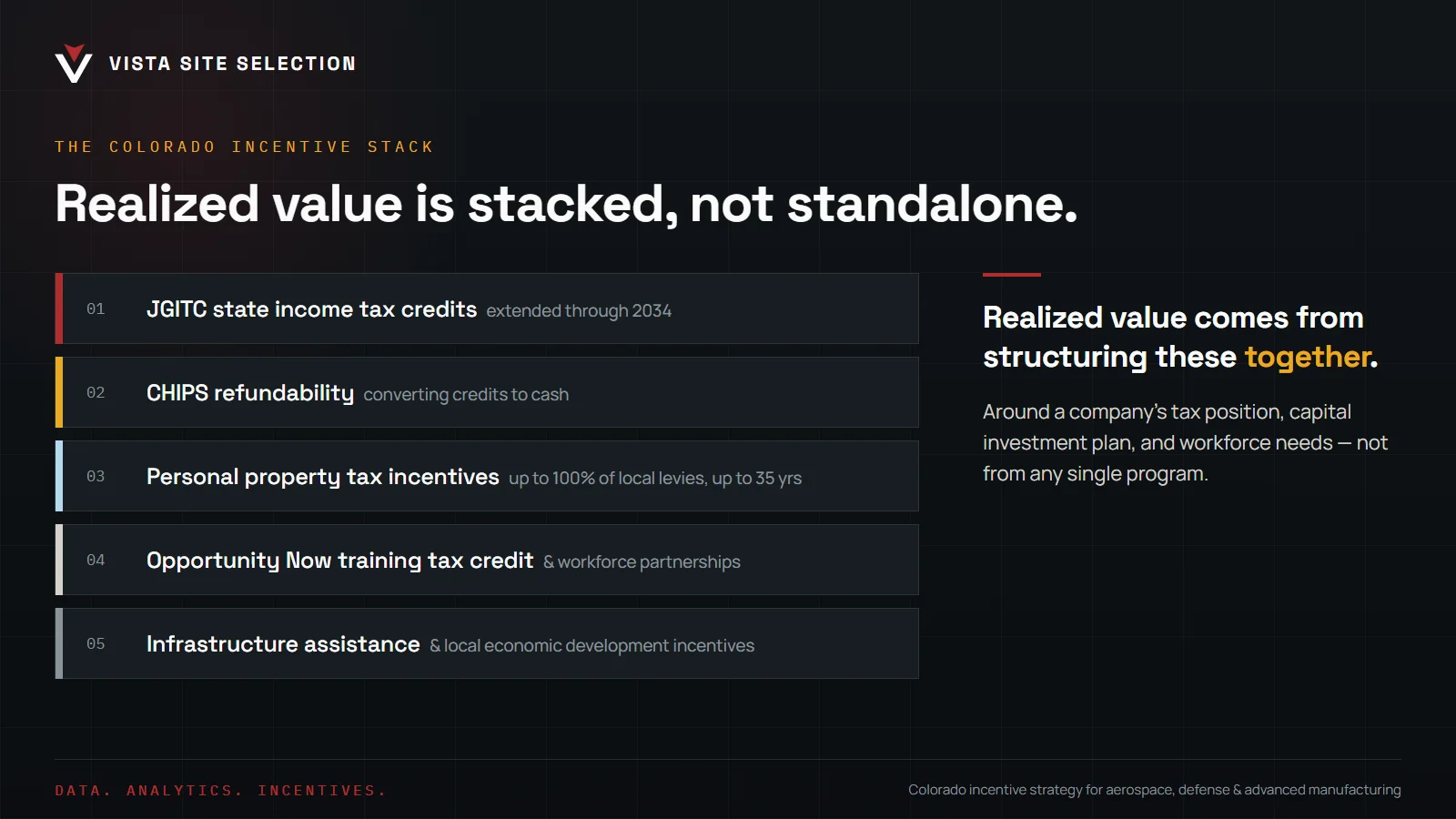
The strongest incentive packages often combine:
- JGITC tax credits
- Colorado’s CHIPS Refundable Tax Credit Program (converting the JGITC from a nonrefundable tax credit into cash at 80% of its value, subject to program capacity)
- Workforce development funding
- The Opportunity Now training investment tax credit
- Infrastructure assistance
- Business personal property tax abatements
- Local economic development incentives
- Educational and workforce partnerships
The key is understanding how these tools work together and structuring them to support a company’s specific operational, workforce, tax, and financial objectives.
How Vista Helps Companies Compete in Colorado
Colorado’s incentive landscape can be difficult to navigate. Understanding program eligibility is only the first step. Companies must also understand how incentives interact with their tax structure, workforce requirements, capital investments, and long-term growth strategy. Additionally, most incentive programs include performance commitments, reporting requirements, and compliance obligations that require ongoing management to ensure companies capture and retain the full value of their incentive awards.
Vista helps aerospace, defense, and advanced manufacturing companies identify, negotiate, and monetize incentive opportunities at both the state and local levels.
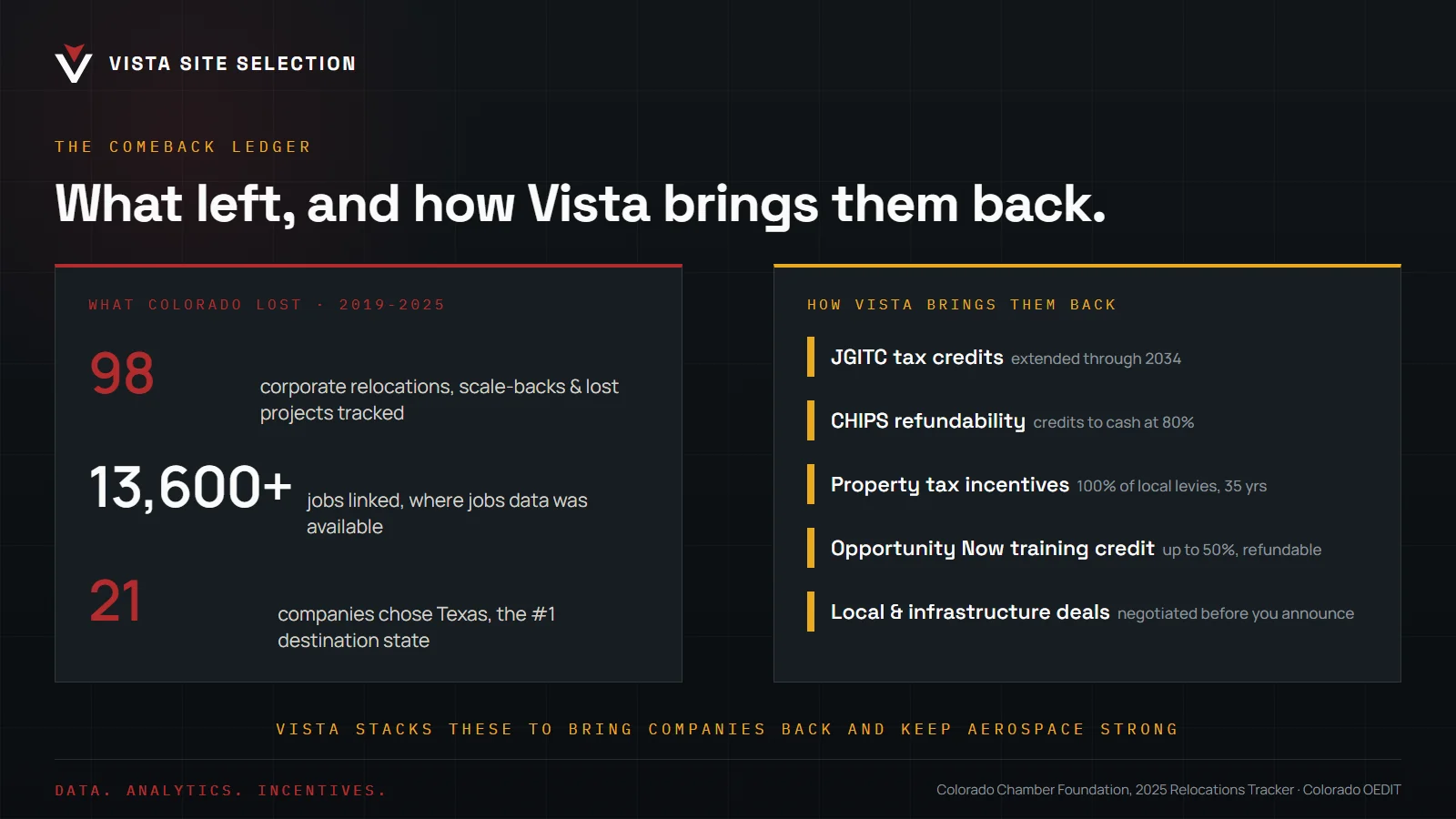
Through recent project experience, our team has successfully helped clients navigate complex Colorado incentive programs, secure JGITC awards, leverage CHIPS-related opportunities, negotiate long-term business personal property tax abatements, and pursue workforce development initiatives including Opportunity Now funding and other local incentive programs.
Our experience has shown that many companies can leave significant value on the table by evaluating incentive programs individually. The greatest value often comes from strategically combining state and local programs into a coordinated package aligned with a company’s workforce needs, capital investment plans, tax position, and long-term operational objectives.
By combining site selection expertise, labor market analytics, incentive negotiation, economic development strategy, and project management, Vista helps clients move beyond headline incentive values and focus on what matters most: realized value.
The result is not simply a larger incentive package.
It is a stronger business case, reduced project risk, and a more competitive location decision.
Turning Colorado Incentives into Business Value
Colorado remains one of the nation’s premier locations for aerospace, defense, and advanced manufacturing investment. However, as competition for projects continues to intensify, companies must evaluate incentives based on how much value they can actually realize rather than the size of the award alone.
The challenge is rarely identifying incentives.
The challenge is understanding how to secure them, structure them, and ultimately monetize them.
At Vista, we help clients navigate that complexity by identifying, structuring, negotiating, and monetizing the incentives that have the greatest impact on project economics. Whether the opportunity involves JGITC, the CHIPS Refundable Tax Credit Program, business personal property tax abatements, the Opportunity Now training tax credit, workforce development programs, or local incentives, our focus remains the same: helping clients create a stronger business case for investment.
Because the most effective incentive is not necessarily the largest incentive.
It is the incentive that can be successfully negotiated, monetized, and converted into measurable business value.
This article is for general informational purposes only and does not constitute tax, legal, or accounting advice. Companies should consult their own advisors regarding program eligibility and credit utilization.
Recent Posts
See All
How to Choose a Site Selection Consultant: 10 Questions to Ask Before You Hire
Start with how the firm gets paid. Matt Samler on the four types of site selection consultants, the 10 questions to ask, and the red flags.
Read more →
GIS Mapping for Site Selection: Understanding What the Location Actually Tells You
William Floyd on GIS mapping for site selection: start with the business question, go deeper than county averages, and test every map before you trust it.
Read more →
The Map Daddy of Site Selection
One guy. Several aliases. One very public experiment. Meet William Floyd, the Map Daddy of Site Selection.
Read more →